
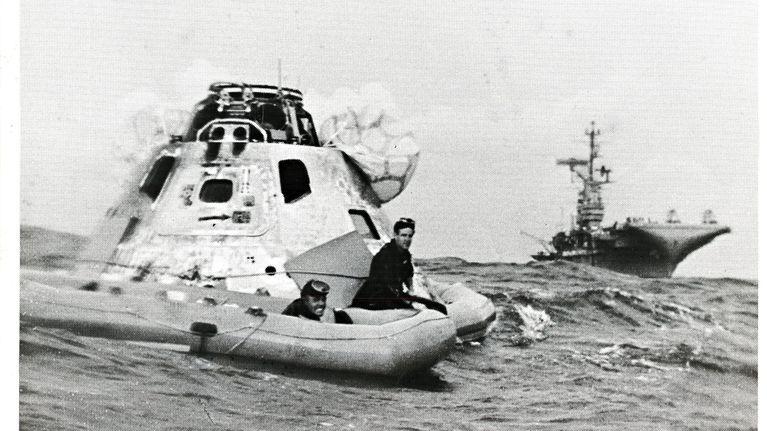
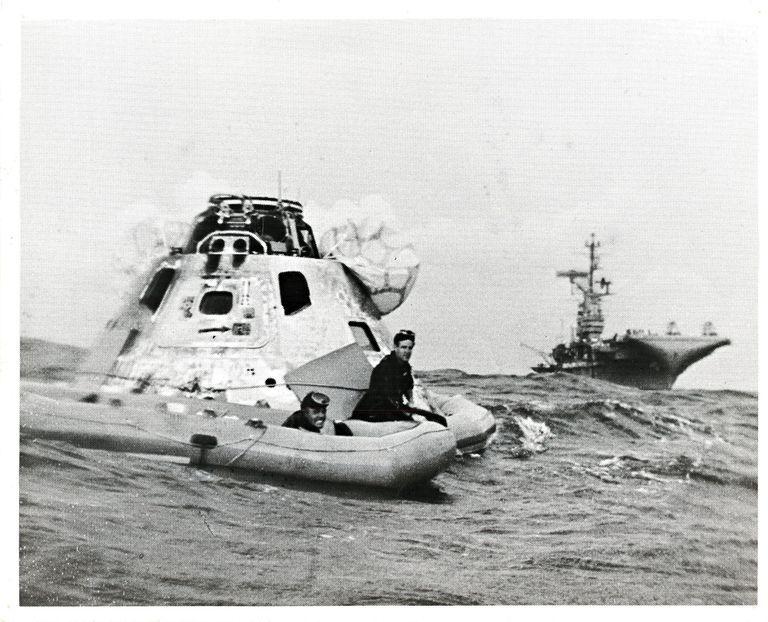
This December, Patriots Point celebrates the 57th anniversary of the Apollo 8 mission — the first manned flight around the moon and one of NASA’s most daring achievements. When the spacecraft splashed down in the Pacific on December 27, 1968, the USS Yorktown (CV-10) served as the primary recovery vessel, a role the Navy fulfilled for all early American space missions.
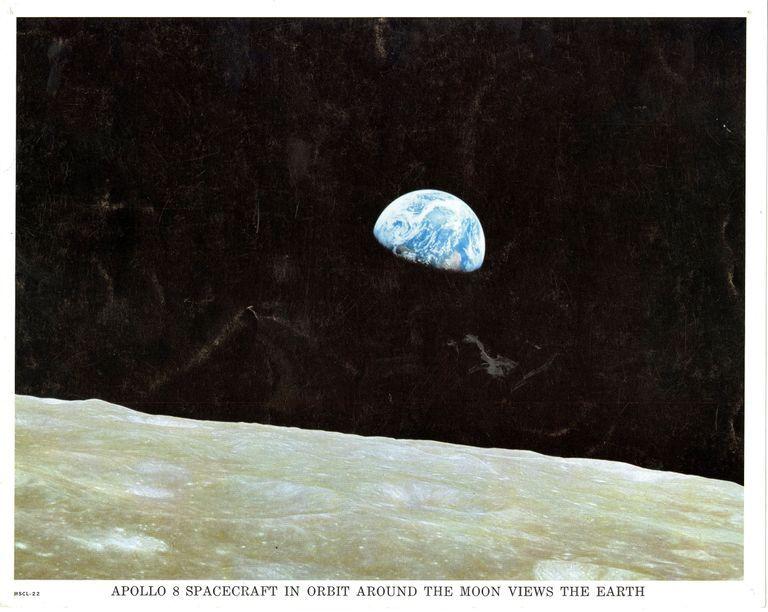
Official NASA photograph, 'Earthrise,' of the view of earth from the Apollo 8 spacecraft in orbit around the moon.
Apollo 8 launched aboard the massive Saturn V rocket and became the first mission to send humans beyond low Earth orbit. Astronauts Frank Borman, James Lovell, and William Anders spent Christmas in lunar orbit, reading the opening verses of Genesis live on television. Anders also captured “Earthrise,” the photograph that helped spark a global environmental movement.
Ahead of the real splashdown, the Yorktown’s crew trained with a dummy capsule, even pushing through rough weather to ensure they were ready. The spacecraft ultimately landed upside-down in heavy seas, leaving the astronauts seasick until three members of Underwater Demolition Team 12 — Bob Coggin, R.J. Flanagan, and Don Schwab — attached flotation gear and stabilized the capsule.
Once the divers helped the crew out, an SH-3D Sea King helicopter from squadron HS-4, piloted by Commander Don Jones, flew the astronauts back to the Yorktown. They were greeted by Captain John Fifield and a red carpet on the flight deck. Medical officers conducted more than four hours of tests, marking the first opportunity to study how the human body responded to deep space. President Lyndon Johnson called to congratulate them while they were in sickbay.
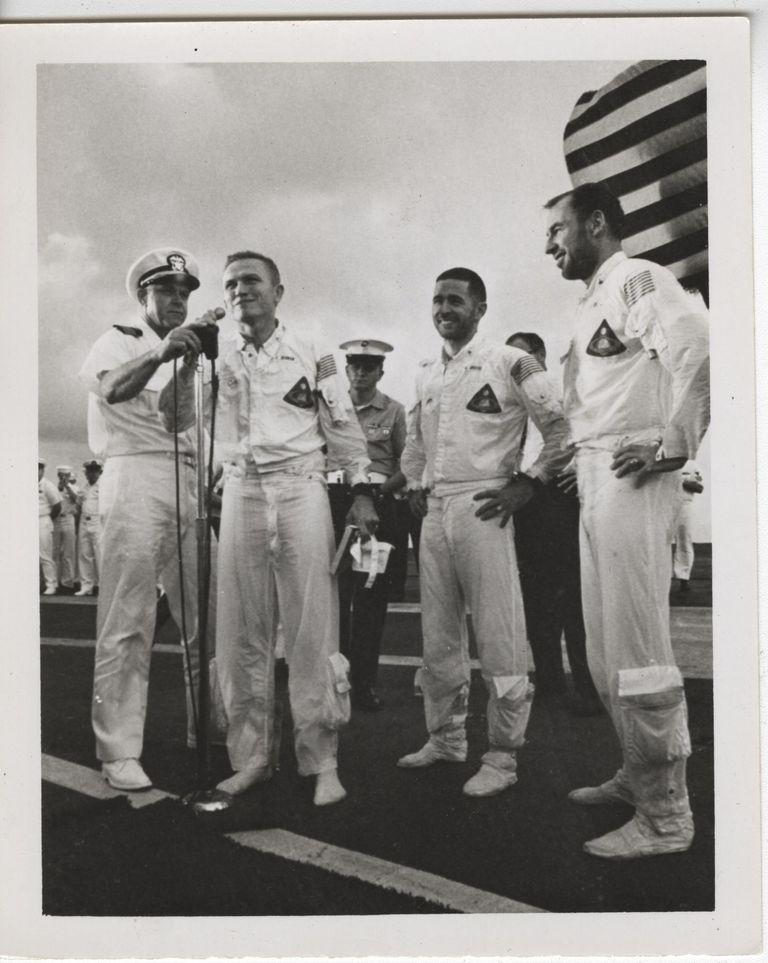
The Apollo 8 astronauts addressing the crew and the media following the recovery of the Apollo 8 capsule. Captain John Fifield holds the microphone for Frank Borman.
During their brief stay aboard, Borman, Lovell, and Anders lodged in the admiral’s quarters, dined with the captain, and were presented with a 14-layer, 500-pound cake. The astronauts departed for Hawaii on December 28, and the Yorktown delivered the capsule the following day.
This year marks the first Apollo 8 anniversary without any surviving crew members. Frank Borman died in 2023 at 95. A West Point graduate, Air Force test pilot, and commander of both Gemini 7 and Apollo 8, he later led Eastern Air Lines. William Anders, who died in 2024 at 90, was an Air Force pilot, nuclear engineer, and the mission’s lunar module pilot. His “Earthrise” photo remains one of the most iconic images ever taken. James Lovell, who recently passed away in 2025 at 97, was a Naval Academy graduate, veteran fighter pilot, pilot of Apollo 8, and commander of the dramatic Apollo 13 mission.
The exhibit tells the extraordinary story of Apollo 8 and the Yorktown, as visitors step inside a replica Apollo capsule and see the original hook and pulley used to recover the craft. The exhibit opens on December 13.